


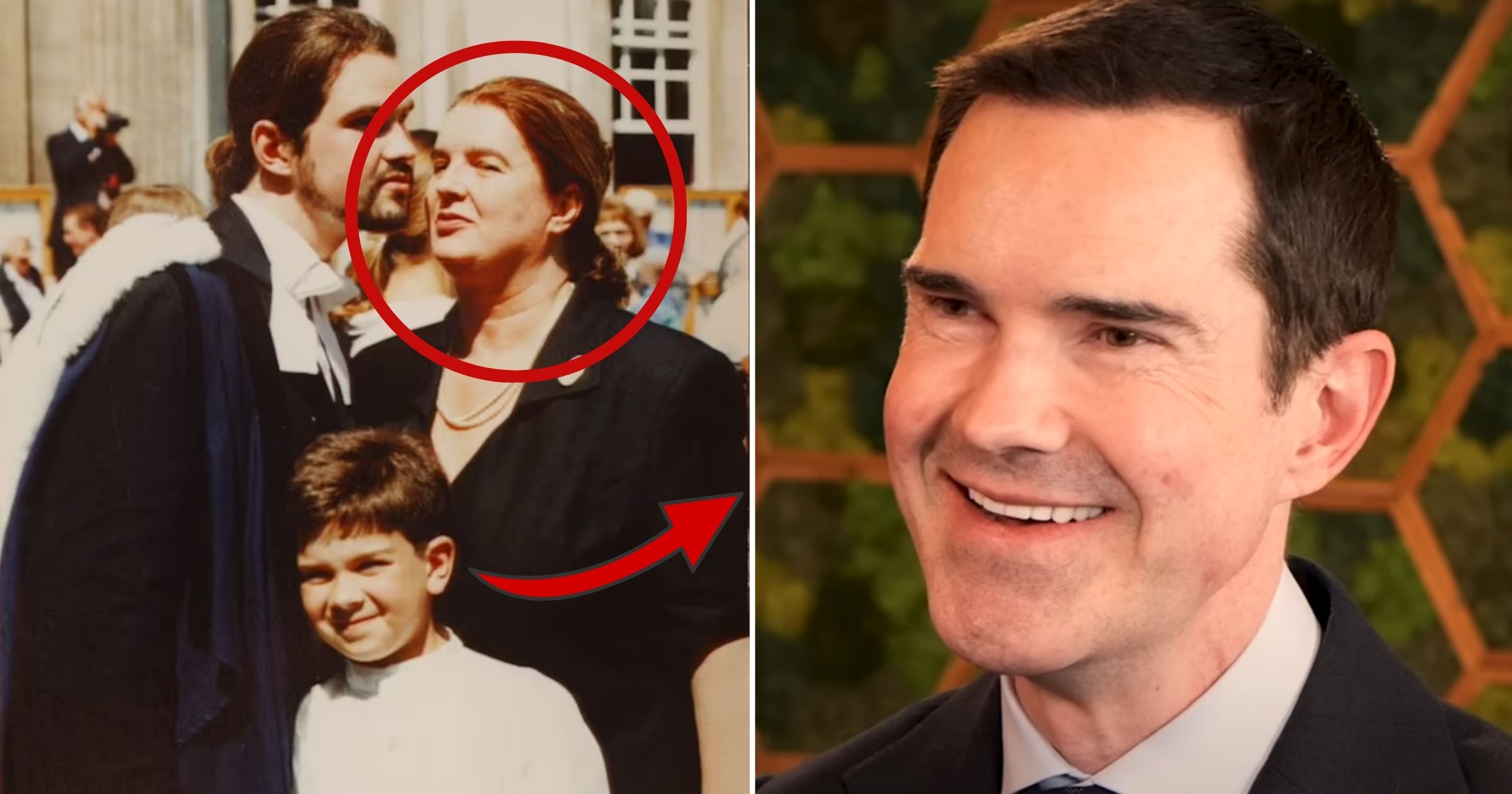
Behind Jimmy Carr’s sharpened one-liners was a mother he remembered not as a celebrity parent, but as the funniest, warmest person in the room.
The name Nora Mary Carr rarely appears without another name beside it: Jimmy Carr. Yet reducing her to “Jimmy Carr’s mother” misses why she still matters in accounts of the comedian’s life. Carr has repeatedly described an unusually close bond with Nora, while his own memoir gives some of the clearest surviving detail about her personality, work, Irish roots and final illness.
That relationship becomes especially significant when the chronology is considered. Nora died in September 2001, only a short time after Jimmy had begun making stand-up comedy a serious career. She therefore saw the earliest stage of his transition from corporate employee to comedian, but not the television career that would later make him a household name through programmes including 8 Out of 10 Cats and The Big Fat Quiz of the Year.
The surviving evidence also reveals a striking contrast between Nora’s public footprint and her private importance. There are no extensive interviews, no established celebrity archive and no reliable record of personal wealth. Instead, her life is reconstructed through Jimmy Carr’s memoir, established profiles of her son, archival biographical records and later interviews in which Carr continued to speak about her.
BLUF: Nora Mary Carr, née Lawlor, was Jimmy Carr’s Irish-born mother and a trained nurse whose humour and emotional support became deeply influential in his life. Born in 1943 and deceased in 2001 at 57, she is remembered primarily through Jimmy’s memoirs and interviews, which describe her as exceptionally funny, charismatic and deeply important to his confidence.
Nora Mary Carr at a Glance
- Full name: Nora Mary Carr, née Lawlor
- Born: 19 September 1943, according to widely repeated biographical records
- Died: 7 September 2001, aged 57
- Nationality/background: Irish
- Profession: Nurse
- Husband: Patrick James “Jim” Carr
- Children: Three sons, including Jimmy Carr
- Family base in England: Farnham Common, Buckinghamshire
- Best documented source: Jimmy Carr’s memoir Before & Laughter
- Known publicly for: Being Jimmy Carr’s mother and a major personal influence on his humour and confidence
The exact place of Nora’s birth is less securely documented than the date associated with her birth. Sources consistently connect the Carr family with Limerick, Ireland, and Jimmy’s memoir specifically states that Nora trained as a nurse at the Regional Hospital in Limerick before moving to London in the early 1970s.
From Limerick Nursing to a New Life in London
Nora’s own story began well before Jimmy Carr became a public figure. The strongest first-person evidence comes from Before & Laughter, Jimmy Carr’s 2021 memoir, in which he identifies his mother as Nora Mary Carr, née Lawlor, and describes her professional training in Limerick. He writes that she trained at the Regional Hospital in Limerick and subsequently moved to London in the early 1970s as a migrant nurse.
That detail matters because it places Nora within a substantial Irish migration story that shaped post-war Britain. She arrived in England as a trained healthcare worker rather than as someone whose identity was built around a famous family. By the time she became the mother of three sons, nursing was one of the defining parts of her adult working life.
The Royal Albert Hall’s archival biography for Jimmy Carr independently identifies his mother as Nora Mary Lawlor and records his parents as Irish. It also identifies his father, Patrick James Carr, as an accountant who later became treasurer for Unisys.
Jimmy’s parents married in 1970 and later separated in 1994, although they never formally divorced. The family raised three sons, with Jimmy occupying the middle position. The family spent much of its English life around Farnham Common in Buckinghamshire, while retaining links to Ireland.
What Nora’s nursing career tells us
Nursing is one of the better-established facts about Nora because it comes directly from Jimmy Carr himself and is independently repeated in later reporting. In 2024, The Independent again identified Nora as a nurse while covering Carr’s recollections of childhood illness and the first time he remembered making his mother laugh.
Beyond that, the public record becomes thin. There is no dependable archive detailing her full employment history, salary, professional promotions or retirement. Claims circulating online that assign Nora other occupations should not automatically override Carr’s own account.
That distinction is important in a biography of someone who never sought celebrity status.
The Mother Jimmy Carr Remembered as the Funniest Person in the House
The most revealing portrait of Nora does not come from a database. It comes from the way her son wrote about her.
In Before & Laughter, Carr presents Nora as loud, affectionate, socially confident and naturally comic. He recalls her laugh, her ability to make visitors feel welcome and the way his friends would sometimes come to the house specifically to see her. His description is unusually personal for a memoir by a comedian better known for controlled one-liners and deliberately provocative stage material.
Carr’s own assessment is blunt: “My mother was, how can I put this, fucking hilarious.”
That description helps explain why Nora occupies such a particular place in his biography. Jimmy was not merely saying that his mother enjoyed jokes. He was describing humour as part of her personality.
He also connected his own comic instincts to her. In the memoir, Carr says he believed that whatever innate comedic talent he possessed came from her. He recalled her as fun, loud and irreverent, with an unusually expressive laugh and an ability to make difficult circumstances feel lighter.
The Guardian’s 2012 profile of Carr adds another important piece of evidence. Jimmy recalled that his mother had been proud when he was accepted to Cambridge and, when he eventually told her he wanted to become a comedian, she was pleased rather than alarmed. Carr said she was more confident in his ability than he was himself.
That is a significant detail. Jimmy’s move into comedy represented a dramatic change from his corporate career at Shell. His mother, according to Carr, recognised something in him before the broader public did.
Nora’s importance to Jimmy was not simply that she encouraged him. He remembered her as someone whose own personality gave him permission to be unusual.
Farnham Common, Three Sons, and the Family World Behind the Jokes
The Carr household was rooted in Farnham Common, Buckinghamshire, where Jimmy grew up alongside his two brothers. Public biographies identify Jimmy as the second of three sons, with Colin Carr and Patrick Carr also part of the family.
This was not a celebrity household. Nora was not a television personality, nor did she build a public career from being connected to her son. Jimmy’s later fame created the public interest in her rather than the other way around.
His memoir nevertheless portrays her as the social centre of the home. He remembered music being played in the house, visits to record shops, dancing, conversations and a mother who could speak comfortably with almost anyone. Those details matter because they give a sense of the environment in which Jimmy developed the comic sensibility later associated with him.
Carr also described Nora as a Catholic and wrote about the religious atmosphere of his childhood. In his memoir, he connected his early understanding of faith to his mother and the religious practices that surrounded the family home.
The public record should not, however, be stretched beyond what Carr actually disclosed. Nora’s precise childhood circumstances, her parents’ names, her complete schooling and most details of her life before marriage remain poorly documented.
That silence is part of the story.
The First Joke Jimmy Carr Remembers Making His Mother Laugh
There is a particularly revealing link between Nora’s career as a nurse and Jimmy’s earliest memories of comedy.
In a 2024 appearance discussed by The Independent, Carr recalled suffering meningitis as a young child and receiving a lumbar puncture in Limerick. He remembered being told the procedure would be painful and responding with the phrase, “You’ve got to be cruel to be kind.” Carr said he believed this was the first thing he ever said that his mother thought was funny.
The memory is significant because it predates the professional comedian by decades. It shows humour appearing in the relationship long before Carr had an audience, television platform or carefully constructed stage persona.
It also places Nora inside one of the earliest stories Carr has publicly told about comedy itself: the moment he discovered that a joke could change the emotional temperature of a room.
His mother was a nurse. She understood illness and medical environments professionally. Her son, still a child, experienced a frightening medical procedure and responded with a line that made her laugh.
That is not proof that Nora “created” Jimmy Carr as a comedian. It is stronger to say that Carr himself identifies her humour as one of the earliest sources of his own comic instincts.
The Career Change Nora Was Alive to See
Jimmy Carr’s professional transformation began before Nora’s death.
Carr studied social and political sciences at Gonville and Caius College, Cambridge, graduating in 1994. He then entered the marketing world and eventually worked for Shell. By January 2000, he had taken voluntary redundancy and began performing paid stand-up comedy.
This chronology changes how Nora’s influence should be described.
She did not simply inspire a future comedian from childhood and disappear from the story. She was alive when Jimmy actually made the difficult transition into comedy. According to Carr’s recollection in The Guardian, she was pleased when he told her he wanted to become a comedian and had greater confidence in him than he initially had in himself.
Nora died in September 2001. The major television phase of Jimmy Carr’s career came later, including The Big Fat Quiz of the Year from 2004 and 8 Out of 10 Cats from 2005.
So Nora saw the beginning, but not the scale of what followed.
She did not see the arena tours, the long-running television shows, international Netflix releases or the decades of professional comedy that established her son as one of Britain’s most recognisable stand-up performers.
September 2001: Pancreatitis and the Loss That Stayed With Him
The circumstances of Nora’s death are among the most firmly repeated details in Jimmy Carr’s biography.
She died in September 2001 from pancreatitis, aged 57. The widely cited date is 7 September 2001. The Guardian and The Independent both confirm the pancreatitis and her age at death, while Carr’s memoir provides the more intimate account of her final illness.
Carr wrote that she died at St Thomas’ Hospital in London and described pancreatitis as a brutal illness with periods in and out of intensive care. He also recalled being told by another nurse that his mother had only hours left, allowing him and his brothers to be present near the end.
That account explains why Nora’s death occupies such emotional space in Before & Laughter. Carr did not treat her death as a passing biographical event. He connected it to mortality, grief, identity and the urgency of doing something meaningful with his own life.
At the time, Jimmy was 28. His mother’s death came less than two years after his first unpaid stand-up performance and roughly a year and a half after his first paid gig. The timing meant that she had witnessed the beginning of his new career, but not its later success.
Why her death became more than a family tragedy
Carr has described grief as something that can force a person to confront mortality. In Before & Laughter, he writes about the shock of losing his mother and the way that experience changed his relationship with life, time and action.
The evidence therefore supports a careful formulation: Nora’s death was a major emotional turning point for Jimmy Carr, and his later memoir explicitly connects that loss with his thinking about mortality and purpose.
It is less defensible to claim that her death single-handedly “caused” his comedy career. Jimmy was already performing before she died. The chronology matters.
The Carr Family Timeline
| Date | Event |
|---|---|
| 19 September 1943 | Nora Mary Lawlor is widely recorded as being born. |
| 1970 | Nora and Patrick James “Jim” Carr marry. |
| 1972 | Jimmy Carr is born in Isleworth, London, as the middle of three sons. |
| Early 1970s | According to Jimmy Carr’s memoir, Nora moves to London after training as a nurse in Limerick. |
| 1994 | Jimmy’s parents separate, although they never formally divorce. |
| December 1999 | Jimmy performs an early unpaid stand-up set in London. |
| January 2000 | Carr performs his first paid stand-up gig after leaving Shell. |
| 2000–2001 | Nora remains alive during the formative beginning of Jimmy’s professional comedy career. |
| 7 September 2001 | Nora dies aged 57 following pancreatitis. |
| 2021 | Jimmy publishes Before & Laughter, providing extensive personal recollections of his mother. |
| 2024 | Carr publicly recalls how his childhood illness led to his first remembered joke making Nora laugh. |
The Evidence Gap: What We Cannot Reliably Say About Nora
There is an important difference between what Jimmy Carr has documented and what later biography websites claim.
Reliable sources support Nora’s name, her Irish background, her work as a nurse, her marriage to Jim Carr, her three sons, her close relationship with Jimmy, and her death from pancreatitis in 2001.
What is far less secure is a detailed account of her own childhood, exact birthplace, complete employment history, personal income, private friendships, later property ownership or individual financial assets.
Several recent online biographies provide precise claims about those subjects, but they do not consistently identify documentary evidence. Some even contradict one another about Nora’s birthplace and occupation. Those discrepancies are precisely why an evidence-led biography should not turn uncertain details into facts.
The same principle applies to her supposed “net worth.”
Financial Record: Why Nora Mary Carr Has No Credible Net-Worth Figure
No authoritative source reviewed provides a verified estimate of Nora Mary Carr’s personal net worth.
Nora was a private individual whose public identity came primarily through her family and through Jimmy Carr’s later recollections. There are no reliable public financial statements, business records or asset disclosures establishing her wealth.
Accordingly, Nora Mary Carr’s net worth is unverified and should not be assigned a numerical figure.
Claims circulating online that attach a specific pound value to her estate should be treated as speculation unless supported by probate records or another authoritative financial document.
Why Jimmy Carr Still Talks About Nora
The strongest evidence of Nora’s continuing importance is not a fan biography. It is Jimmy Carr’s own repeated decision to return to her.
In Before & Laughter, Carr remembered the details of her laugh, music she enjoyed, the way she interacted with his friends, the support she gave him and the emotional devastation of losing her.
Years later, he was still discussing her when reflecting on his childhood, including the meningitis episode in which he remembered making her laugh for the first time.
The Guardian’s earlier profile also captured the same central point: Carr remembered his mother as someone who understood him, supported his ambitions and believed in him before he had fully found his own confidence.
That consistency across a memoir, interviews and established profiles is more meaningful than the embellished claims found in weaker online biographies.
Nora did not need a public career of her own to have a documented effect on one.
Frequently Asked Questions About Nora Mary Carr
Who was Nora Mary Carr?
Nora Mary Carr, née Lawlor, was Jimmy Carr’s mother and a trained nurse with Irish roots. Jimmy’s memoir identifies her as a nurse who trained in Limerick before moving to London in the early 1970s. He remembered her as exceptionally funny, warm, sociable and highly influential on his sense of humour and confidence.
Was Nora Mary Carr a nurse?
Yes. Nora Mary Carr was a nurse, according to Jimmy Carr’s memoir and later reporting. Carr wrote that she trained at the Regional Hospital in Limerick, Ireland, before moving to London in the early 1970s. The Independent also identified her as a nurse when reporting Carr’s childhood memories in 2024.
When did Nora Mary Carr die?
Nora Mary Carr died in September 2001 at the age of 57. The widely cited date is 7 September 2001, and Jimmy Carr’s memoir identifies pancreatitis as the illness that led to her death. The Guardian and The Independent independently confirm that she died from pancreatitis aged 57.
How did Nora Mary Carr influence Jimmy Carr?
Nora influenced Jimmy Carr primarily through her personality, humour and emotional support. Carr has said that she was exceptionally funny and that he believed his natural comic talent came from her. He also recalled that she encouraged his decision to become a comedian and believed in his ability before he fully trusted himself.
Did Nora Mary Carr see Jimmy Carr become famous?
No. Nora died in September 2001, before Jimmy Carr became a major television personality. His television career expanded in the following years, including The Big Fat Quiz of the Year from 2004 and 8 Out of 10 Cats from 2005. She did, however, live long enough to see the beginning of his professional stand-up career.
Where is Nora Mary Carr now?
Nora Mary Carr died in 2001, so there is no current personal life to document. Her continuing public relevance comes from Jimmy Carr’s memoirs and interviews, particularly his reflections on her humour, nursing career, family life and death. Current claims about private relatives, assets or undisclosed personal history should not be treated as verified without evidence.
The Part of Jimmy Carr’s Story That Belongs to Nora
Nora Mary Carr left behind no conventional celebrity archive. There is no long television record, no public-facing career brand and no extensive catalogue of interviews.
What survives instead is more intimate.
Her son remembered a nurse from Ireland who moved to London, raised three boys, filled a home with humour and music, encouraged Jimmy when he chose comedy over corporate work, and remained one of the central emotional figures in his life.
Her death in 2001 came before the biggest chapter of his career, but not before its beginning. That distinction explains much of the poignancy surrounding her story.
For Jimmy Carr, Nora was not simply the person who gave him his surname. She was, in his own account, one of the people who taught him how to see the absurd side of life—and how laughter could make frightening moments bearable.
Sources & Verification
- Jimmy Carr, Before & Laughter — primary autobiographical source for Nora’s name, nursing career, Limerick training, move to London, personality, family memories and death. The book was published by Quercus in 2021. Jimmy Carr — Before & Laughter, official site
- Hachette UK — publisher record confirming Before & Laughter, its author, Quercus publication details and memoir classification. Hachette UK — Before & Laughter
- Royal Albert Hall Collections — archival biographical record identifying Jimmy Carr as the son of Patrick James Carr and Nora Mary Lawlor and documenting his Irish family background. Royal Albert Hall — Jimmy Carr archival record
- The Guardian / The Observer — established profile covering Carr’s parents, his close relationship with Nora, her death from pancreatitis and her encouragement of his comedy ambitions. The Guardian — Jimmy Carr profile
- The Independent — 2024 reporting on Jimmy Carr’s childhood meningitis story and confirmation that Nora was a nurse who died in 2001 aged 57.
Editorial Disclaimer
This article distinguishes between facts supported by Jimmy Carr’s own memoir, archival records and established journalism and claims repeated only by secondary biography websites. Nora Mary Carr was a private individual, so details including her precise birthplace, full employment history, personal finances and later private life are not presented as fact where authoritative evidence is unavailable. The evidence in this article was reviewed through 3 September 2026.
